Blog · Guides
How to keep RFP answers current without maintaining a content library
A content library goes stale because every entry is a copy. AI RFP tools that draft from your live documents fix most of that. Here is how it works, and the part that still needs a person.
 Thomas KrawczykVP Marketing, Tribble · Published · 9 min read
See a correction reach every open RFP. We will show you how Tribble carries one approved change into the answers already in progress.
An AI RFP tool keeps RFP and security questionnaire answers current by drafting from the documents your teams already keep up to date, and re-reading them on a schedule, instead of from a library of saved answers that someone has to refresh by hand. Two jobs stay with people: every source needs an owner, and when two sources disagree, someone who knows the facts has to say which one is right.
It is the question buyers ask us most. In 10 of the 28 prospect calls we reviewed from July to October 2026, someone asked a version of it: who keeps the library up to date, what happens when a policy changes, how do we stop last year's answer going out again. Hallucinations came up in 6.
Why content libraries go stale
A library entry is a copy of a fact. Someone wrote it against the policy, the product or the price list as it stood that day, and from then on it lives apart from the thing it describes.
When the source changes, nothing tells the copy. The security team updates the data residency policy in SharePoint, and the library still says what it said in March. The next RFP pulls the March answer, a reviewer who has not heard about the change approves it, and it goes to a buyer. Nobody did anything wrong. There were two versions of the fact, and only one of them was being maintained.
Our platform is changing very rapidly, things change in a matter of days or weeks and then that is not captured.
An RFP process lead, on a call with us in August 2026
Most teams answer this with calendar reviews: every quarter, each owner is asked to re-read their answers. That catches some drift, late, and the job grows with the library. It also reviews on the wrong trigger. An answer goes out of date when its source changes, not when the quarter ends.
Libraries are not useless. They are good at holding a short position that has been worded with care and approved, such as your standard answer on limitation of liability. The trouble starts when a copy becomes the main store for facts that change.
Draft from the documents your teams already update
The fix is to stop keeping a second copy. An AI RFP tool that connects to your sources drafts each answer from the policy, the product documentation, the past proposal or the call notes themselves. The people who own those documents already keep them current as part of their job, and the answers follow.
In Tribble, sources stay where they live, in SharePoint, Confluence, Google Drive, Box, Salesforce, Gong and others. Each keeps the permissions it already has, and each re-syncs on a schedule.
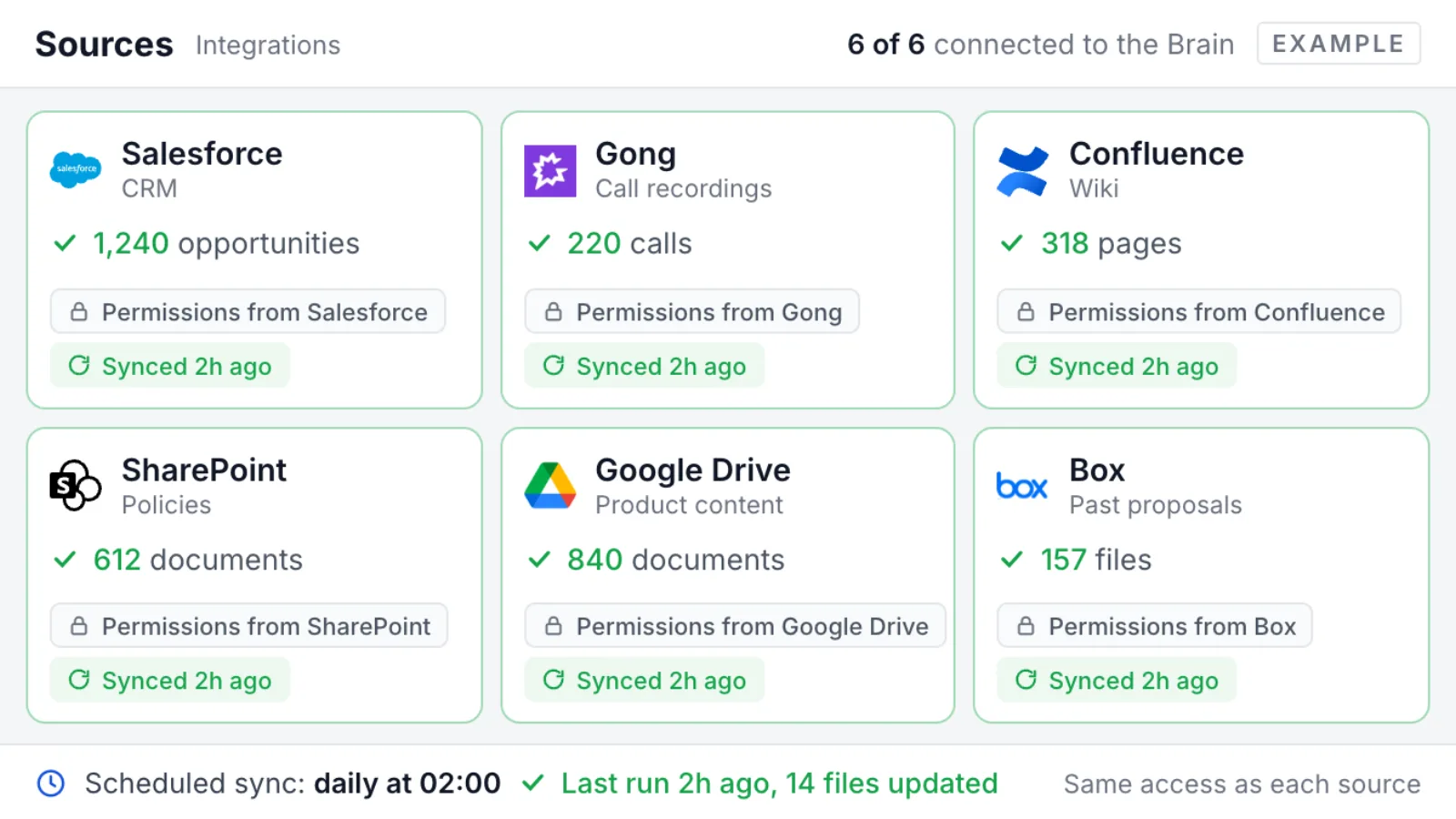
Two details in that screen matter more than the logos. The sync runs on a schedule, so nobody has to remember to refresh anything. And the permissions come from the source, so an answer never draws on a document the person asking could not already open.
Make "current" something you can check
An answer you cannot trace is an answer you cannot trust to be current. Every answer should show the document it came from, who owns it and when it was last approved. That turns "is this still right?" from a guess into a glance. One evaluation lead put the need plainly on a call with us: to understand how old the content is, and where the conflicting entries are.
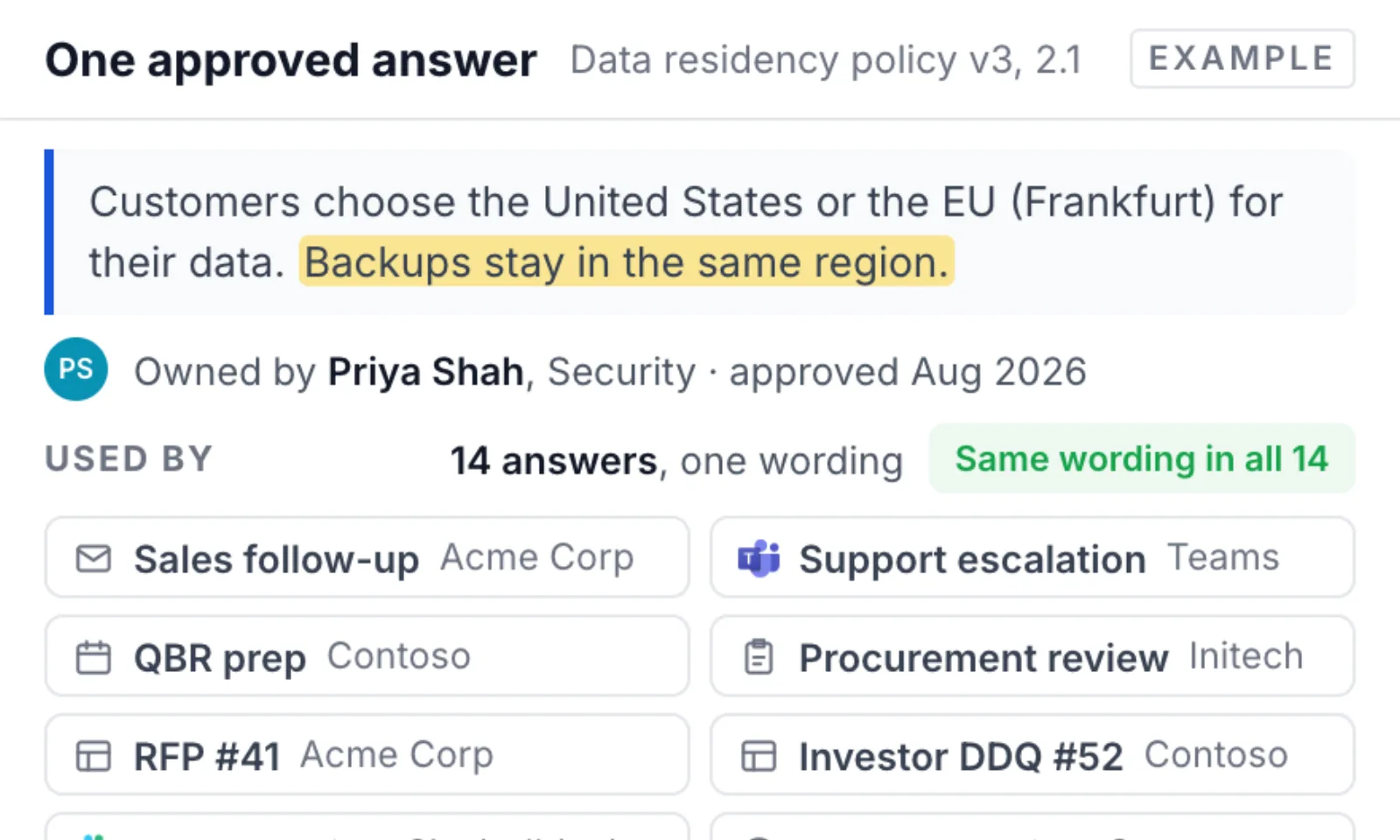
It also means one fact has one wording. When the same data residency answer appears in an RFP, an investor DDQ and a sales follow-up, it should be the same sentence from the same source, not three paraphrases slowly drifting apart.
Fix it once, everywhere it was used
The hardest part of a change is not the next RFP. It is the six that are already half done. With a library, the corrected entry helps the next draft, while the answers already pasted into open projects keep the old wording until someone finds them by hand.
Tribble works the other way round. When a correction is approved, it updates the answers already drafted in open projects, as well as future drafts.
The example below shows the kind of change a sync cannot catch. The 2026 audit report, which added the Frankfurt region, was not in SharePoint yet. A sales engineer mentioned it on a prospect call. That correction, approved once, reached every open answer that used the old wording, from a vendor RFP and an investor DDQ to a SIG Lite and a Slack thread.
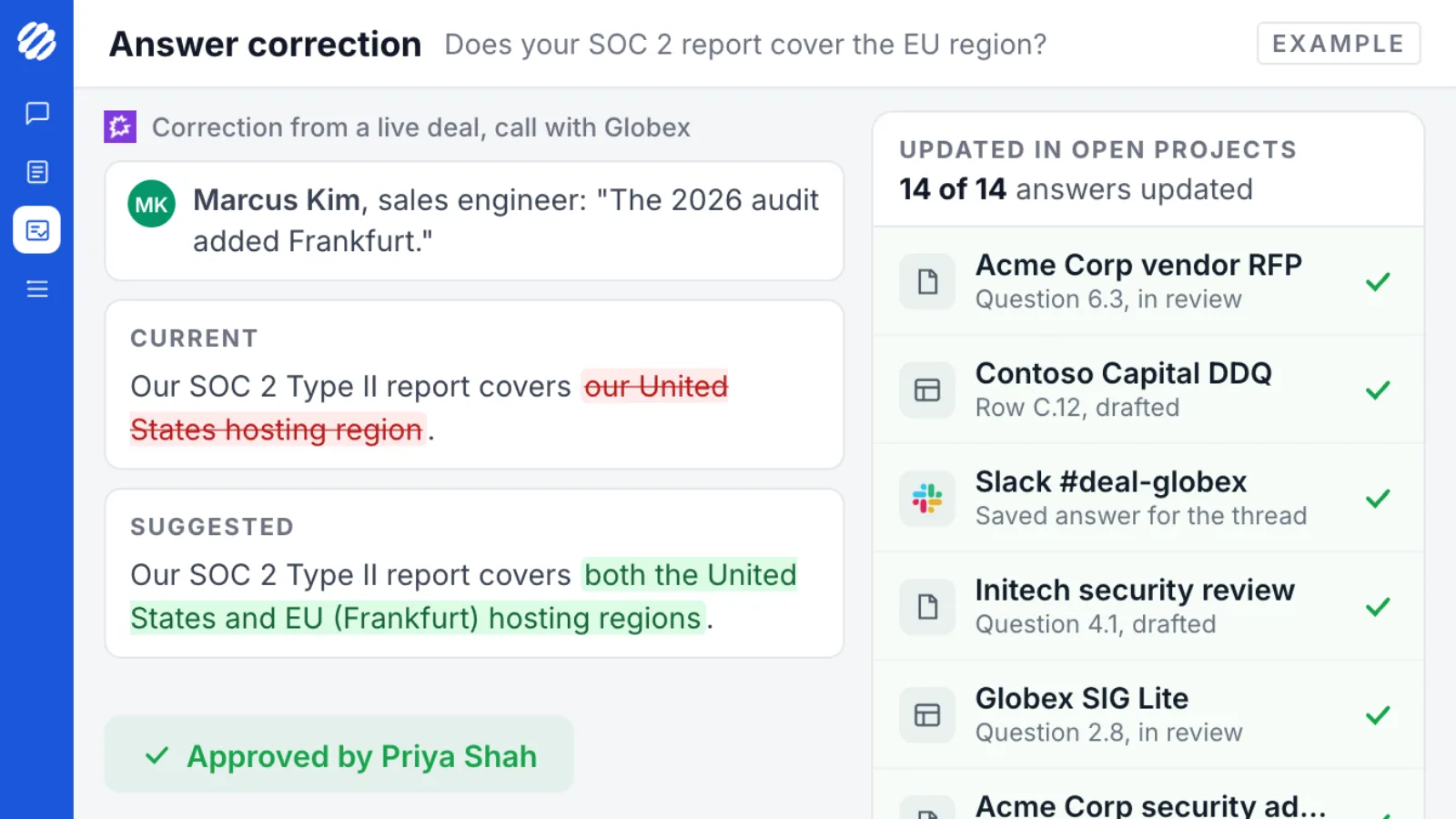
Tribble also watches for the quieter version of the problem: two sources that disagree, or a source that has fallen out of date. It routes those to the source's owner rather than picking a winner on its own, and every answer keeps a history of who changed it and when, so you can see later why it says what it says.
What still needs a person
Drafting from sources moves the upkeep. It does not remove it. Three jobs stay with people.
- Owning the source. A sync makes answers match the document. If the document is wrong, the sync spreads the wrong answer faster. Every source that feeds answers needs a named owner who keeps it right.
- Deciding between sources. When the security policy says one thing and a newer slide deck says another, a tool can notice the conflict. Someone who knows the facts has to say which is true.
- Writing down what lives in people's heads. A commitment made on a call, or a product change nobody has documented yet, cannot sync from anywhere. It has to be written down and approved once, as the Frankfurt correction was. After that, it behaves like any other source.
There is also a small gap by design. A scheduled sync picks up a change at its next run, so a policy edited this afternoon reaches new answers after the next sync, not the moment it is saved.
Four things to try in a trial
Every vendor in this category says its answers stay current. These are the checks that show whether it is true, each with what you will see in Tribble. Each takes a few minutes with a trial account.
Change a fact in a source document, then ask the question again. A good tool reflects the change once it has re-read the source. Ours picks it up at the next scheduled sync.
Correct an answer once, then open a project that already used the old wording. If that answer has not changed, the correction only helps future drafts. Ours updates the answers already in progress.
Ask where an answer came from. You should see the document, the owner and the approval date without leaving the answer. All three sit on every answer.
Load two documents that disagree, and ask the question they disagree on. A tool that silently picks one is hiding the problem. Ours routes the conflict to the source's owner to decide.
If a tool passes all four, the library question mostly goes away. If it passes only the first, you have a faster way to keep the same old copy.
FAQ
Questions buyers ask
How often should an RFP content library be reviewed?
Teams that keep a library usually review it on a calendar, often quarterly, with each owner re-reading their answers. A better trigger is change: review an answer when its source changes. That needs a tool that drafts from connected sources and shows each answer's owner and approval date.
How do you avoid outdated answers in security questionnaires?
Draft security answers from the current policies and reports rather than saved copies, and show the source and approval date on every answer so a reviewer can see how old it is. When a policy changes, the correction should update the answers already in progress, not only the next questionnaire. Tribble does both.
Do you still need a content library with AI RFP software?
You still need approved knowledge, but not a second copy of everything. Keep short, carefully worded positions, such as legal language, as approved answers. Let everything else come from the documents your teams already maintain, synced on a schedule.
Which sources can an AI RFP tool keep in sync?
It depends on the tool. Tribble connects to SharePoint, Confluence, Google Drive, Box, Salesforce and Gong, among others, and keeps each source's own permissions. Ask any vendor which connectors re-sync on a schedule and which still need a manual upload.
See how Tribble keeps answers current
A walkthrough with our team shows how Tribble drafts from your connected sources, puts the owner and approval date on every answer, and carries one approved correction into every open project.
Book a demo★★★★★ Rated 4.7/5 on G2 (Source: G2.com, Inc.)